

Strategies for Giving to Others
Seeing these strategies in the bigger picture
Giving to others can be deeply rewarding, but it can also leave us wondering when to step in, how best to respond – or whether to step in at all – and what might be most helpful in any given situation.
The Five Portals is practical reflective strategy for giving to others within the Ecology of Giving. It offers a way to pause, reflect, and bring greater awareness to how we give and respond to others in our lives.
Inspired by the Four Gates of Speech teaching, The Five Portals is our contemporary adaptation of the enduring wisdom of approach our words and actions with truthfulness, kindness, and care.
The figure below shows how this strategy connects within the broader frameworks and ideas that underpin our Curriculum of Giving.
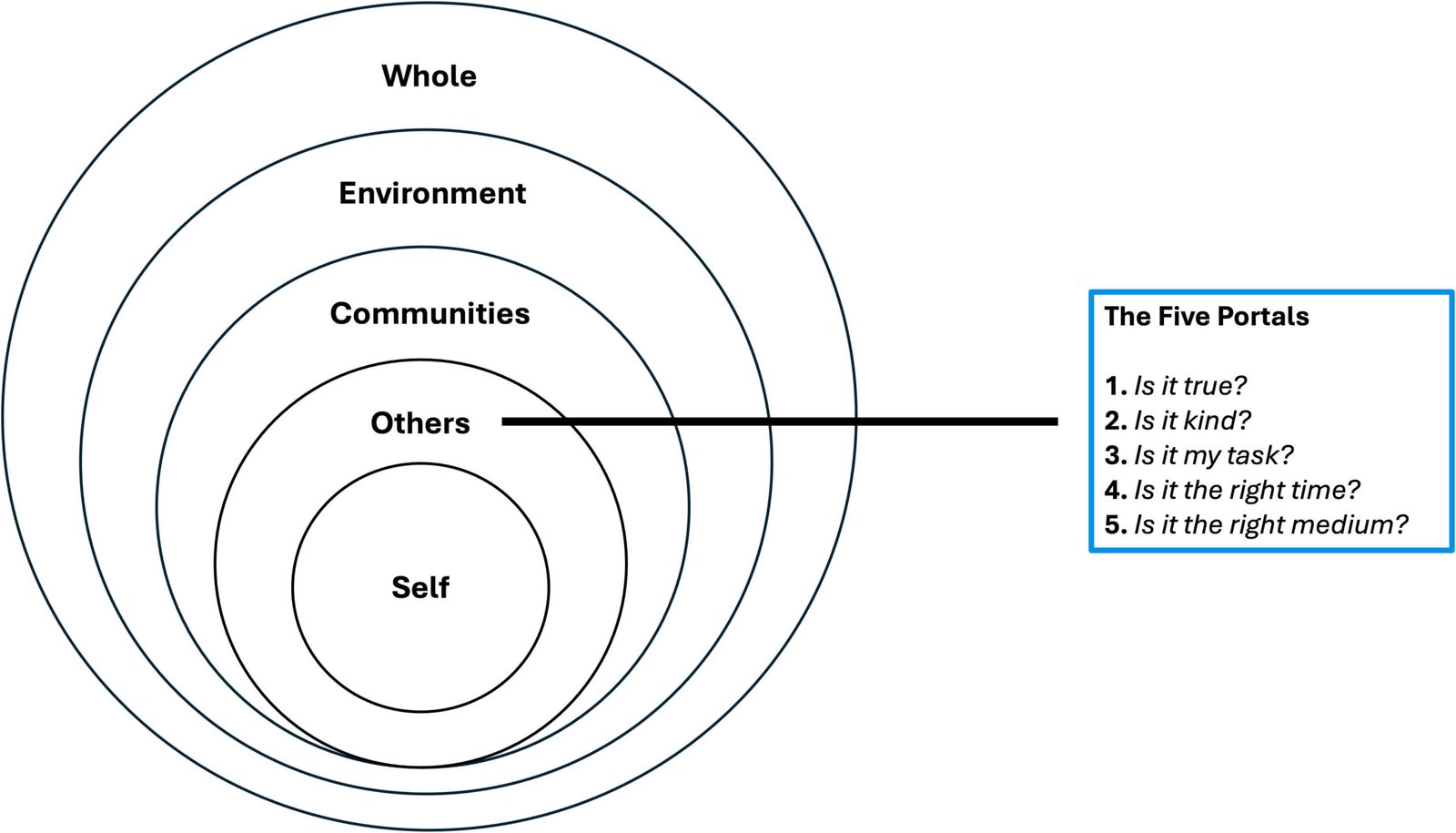
The Five Portals
The Five Portals are a simple reflective tool for those moments when you are unsure whether to step in, speak up, or give to another person.
As educators, parents, and caregivers, we are constantly making these small decisions. Should I say something? Is this really my place? Should I wait? How can I say this in a way that is more likely to be heard?
The Five Portals offer a way of considering whether, when, and how to act. Sometimes the most appropriate action will be choosing not to act.
As you read through each portal, think about a recent interaction where things could have gone more smoothly. Use this experience to gently reflect on what might have gone differently and consider one thing you could try next time you encounter a similar situation.
Portal ONE
Is it true?
Is what I am noticing or thinking actually true?
Before stepping in, pause and check your assumptions. Is there genuinely something that needs to be addressed, or am I reacting because I feel irritated, anxious, uncomfortable, or responsible for fixing the situation? What do I actually know, rather than what am I assuming?
Portal Three
Is it my task?
Is this mine to address?
Even when something is true, and would be kind or helpful to say, it may not be our role to say it. We can notice what another person might need to do differently, while overlooking that it may be someone else’s role or responsibility to address it.
Ask yourself: Is this mine to address, or would it be more appropriate for someone else to take this on – for example, their supervisor?
Portal TWO
Is it kind?
If it is true, is it kind and helpful to say it?
Not everything that is true needs to be said, and not everything we believe to be true will be experienced by another person as helpful. Consider whether your words will support the person’s dignity and wellbeing. Sometimes kindness means saying something difficult; sometimes it means choosing not to say it.
Portal Four
Is it the right time?
Is now the right time to act or speak?
Something can be true, kind, and our task to address, but then we choose the wrong time to do it.
If you or the other person is upset, overwhelmed, or still processing what has happened, a conversation may be more productive later. Choosing the right time can make it easier for someone to be open to something that may be difficult to hear.
Portal Five
Is it the right medium?
What is the best way to communicate this?
The way we communicate matters. A message sent by email or text can easily sound different from how we intended it, because much of our tone, warmth, and empathy can be lost in writing. Sometimes a face-to-face conversation, a phone call, or simply being alongside someone allows us to communicate the humanity behind our words. Consider not only what you want to say, but how it is most likely to be received.
The Five Portals in practice
Here’s an example of how the Five Portals can work in practice.
The other day, I (Thomas) drove into a car parking complex and almost ran over two teenage boys who were suddenly racing down the ramp on a single, shared skateboard. I stopped the car and walked over to them, which gave me a moment to prepare myself. These teenagers were probably not going to care much about what I said unless I made sure I said it in the right way. They might even resent ‘another adult telling them off’, so to speak.
When I reached them, I said, “Boys, if I had run you over just now, I would be devastated. Do you think you could go somewhere safer to do this, please?”
They looked at me a little perplexed, but agreed. After I had parked my car, I saw the boys walking quietly down the road.
I think being aware of, and working with, the Five Portals helped me approach the situation the way I did. It was factual—it was true that what they were doing was dangerous. It was also kind to let them know, because there was a genuine safety issue. I felt it was my task to say something, as there were no other adults around at that moment, and it needed to happen straight away—it was the right time. And by making sure I communicated with empathy and honesty when I approached them face to face, I was using the right medium. Together, these things helped them to hear and accept what I was asking.
As with many situations, I didn’t have time to literally work through the Five Portals before I spoke to the boys. But by knowing the Portals, and by being committed to using them wherever possible, we can begin to use them more intuitively.
As a teacher and educator myself, I am now very used to using empathetic statements in situations of conflict. I know from experience that when people feel understood, they are much more likely to hear and accept what we are trying to communicate.
Like other strategies, the Five Portals is a practical tool that helps us get started with some important principles. As we become more familiar with those principles, we can draw on them more quickly, adapt them more naturally, and apply them across many different situations.
Also explore…
Contact Info
Let’s Chat
Curious about what the Curriculum of Giving might mean for your school or organisation?
We’d love to hear what you’re thinking about, trying, or noticing, and explore what might be possible together.