
Strategies for Giving to Self
Seeing these strategies in the bigger picture
How we care for ourselves shapes how we are able to care for others.
For educators, parents, and caregivers, giving can be deeply rewarding—but it can also be demanding. Making space to notice our own needs, responses, and resources is an important part of sustaining our capacity to give.
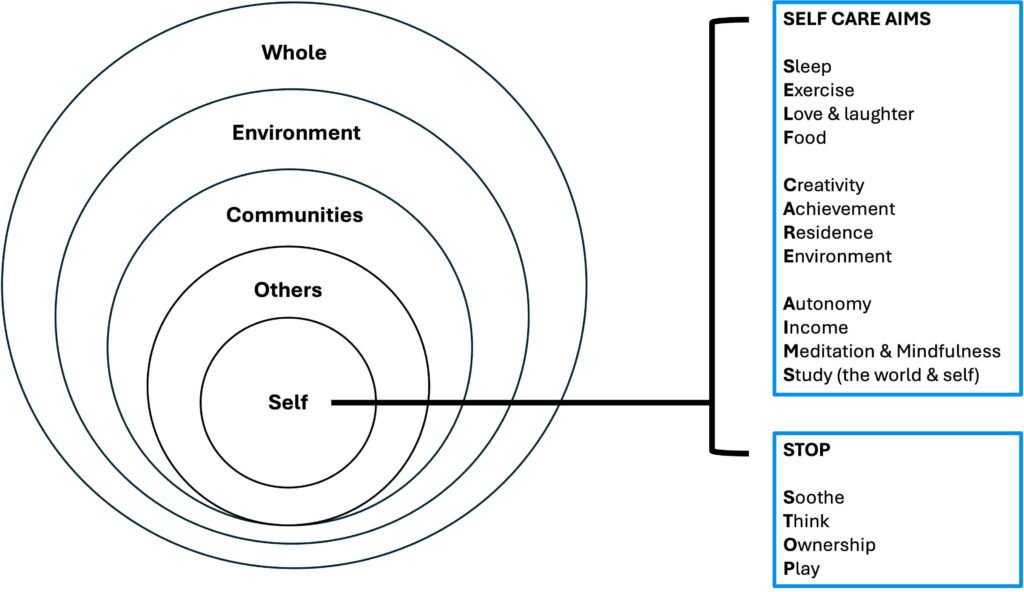
Within the Ecology of Giving, SELF CARE AIMS and STOP offer two ways of understanding and practising giving to ourselves. As you explore them, consider what they might reveal about your own ways of caring—and how they might help you support children and young people to care for themselves too.
These strategies are part of a bigger picture—the Curriculum of Giving. The figure below shows how they connect with the broader frameworks and ideas that underpin our philosophy.
SELF CARE AIMS
When we fly, we are told that in the event of an emergency, we should put on our own oxygen mask before attending to others. In much the same way, it is difficult to give to others if we don’t first give to ourselves enough of the ‘oxygen’ we need.
SELF CARE AIMS brings together key areas we can attend to when giving to and looking after ourselves. Its name serves both as a mnemonic for remembering these areas and as a reminder that caring for ourselves is an important part of giving. We will not always have all of these areas in perfect balance. Rather, the aim is to become aware of what we need and find a “balance in motion” across these domains over time.
The ‘SELF’ part of the acronym focuses on our basic needs and can provide a helpful starting point for teaching children—particularly in early childhood—how to care for themselves.

S- Sleep: Most adults need around seven to eight hours of sleep each night, while children and teenagers generally need more. Both too little and too much sleep can negatively affect our health, wellbeing, and daily functioning. Good-quality sleep supports our immune system, mood, thinking, and overall health.
Take a moment to reflect on your sleep habits. Do you usually wake feeling refreshed and energised, or struggle to stay awake during the day? Consider whether changes such as establishing a regular bedtime, reducing work and technology before bed, or incorporating relaxation practices could help you get better-quality sleep. For more tips on healthy sleeping, visit: http://www.sleephealthfoundation.org.au

E – Exercise: The human body is made to move. Regular physical activity supports our physical health and can help prevent chronic disease, while also benefiting our psychological wellbeing by reducing stress, anxiety, and depressive symptoms.
Aim to include movement in your everyday life. This might involve walking, cycling, swimming, gardening, exercise classes, sport, resistance training, or simply taking regular breaks from sitting. Everyday activities such as taking the stairs, walking instead of driving, cleaning, and gardening all count too.
Think about how much movement you get across the week. What types of activity do you enjoy, and what fits naturally into your lifestyle? Keeping a simple record of your activity can help you identify opportunities to build more movement into your day. For more tips on exercise, visit: https://www.health.gov.au/topics/physical-activity/24-hour-movement-guidelines-for-all-australians?language=en

L – Love & Laughter: We put Love and Laughter together because laughter is good for our health and happiness, and because we often share it with our friends and loved ones. Meaningful and nurturing relationships provide an important source of support, helping us to de-stress, recharge, and experience a sense of belonging and connection.
Giving to ourselves in this domain means recognising the importance of love, laughter, and supportive relationships in our lives—and making time to nurture them. This might include spending time with people whose company we enjoy, staying connected with those who matter to us, showing affection, expressing appreciation, being playful, or offering thoughtful and caring gestures. In doing so, we also help others experience their own needs for love, connection, and laughter.
Not all relationships are positive or supportive. In these situations, caring for ourselves may involve setting boundaries, seeking support, strengthening other positive relationships, or working towards healthier patterns of communication, respect, and trust.
Take a moment to reflect: When was the last time you spent time with people you enjoy? How often do you give and receive love and laughter in your relationships? For more information or support on respectful relationships, visit: https://www.relationships.org.au

F – Food: Our bodies need nourishing food and adequate hydration for optimal health and wellbeing. Diets high in processed foods, salt, saturated fat, and added sugars are associated with a range of health risks, while diets rich in fruits, vegetables, nuts, whole grains, and other minimally processed foods support good health.
Water is also essential for almost every function of the body. While our individual needs vary according to factors such as age, activity, and environment, staying well hydrated is an important part of caring for ourselves.
Take a moment to reflect on your current eating and drinking habits. How well do they support your health and wellbeing? Where possible, consider incorporating more whole, nourishing foods and choosing water regularly throughout the day.
Healthy habits are particularly important to establish early in life. For children, learning about nutritious food and hydration can also be connected with healthy hygiene practices, such as handwashing, food preparation, and safe food storage. For more tips on healthy eating visit: https://www.eatforhealth.gov.au/
The ‘CARE AIMS’ part of the acronym brings the basic needs together with higher-order psychological needs and other life areas that contribute to our wellbeing.

C- Creativity: How creative we are varies from person to person, but research suggests that we all benefit from having a creative outlet in our lives. Whether it is music, writing, art, photography, design, cooking, movement, performance, or simply a hobby or craft, finding ways to express our ‘inner’ self can have a positive impact on our health and happiness.
Creative engagement can also help reduce stress, anxiety, and mood disturbances, and provide a way to explore our emotions and process difficult experiences.
Take a moment to consider what allows you to express your ‘inner’ self. Creativity does not have to be arts-based—it might be as simple as preparing a beautiful meal, getting dressed in a way that makes you feel good, or writing an expressive letter to someone you love. Be open to inspiration, and consider making more time for activities or passions you have always wanted to explore. You might even find ways to share them with friends, family, or loved ones.

A – Achievement: Whether we are high achievers or not, we all need to feel that we are achieving something. Goals, dreams, and a vision for the present and future can give our actions purpose, structure, and motivation, while helping us meet our psychological need for competence.
Our goals can be extrinsic—such as financial success, recognition, or physical attractiveness—or intrinsic, such as personal growth, meaningful relationships, and contributing to our communities. Research suggests that pursuing intrinsic goals is more strongly associated with wellbeing, while pursuing extrinsic goals alone can be associated with poorer wellbeing.
This connects closely with meaningful living. Achievements that involve developing ourselves, building deep relationships, and giving to others and future generations can be particularly meaningful.
Take a moment to reflect on your own goals. What would you like to achieve in the present and future? Are your goals meaningful to you, or are they driven primarily by external measures of success? How often do you notice and celebrate what you have already achieved?
Achievements can be small or significant. What matters is having something worthwhile to work towards and recognising the sense of accomplishment and competence that comes from making progress.

R – Residence: Whether we live in a camper van or a mansion, we need a space where we can be ourselves, recharge, and gather ourselves. Our physical dwellings can provide a sense of security, safety, protection, and privacy, while our attachments to meaningful places and objects can support our sense of identity and psychological wellbeing.
Luxury is not essential. Order, cleanliness, functionality, and aesthetic beauty can all contribute positively to our mood and state of mind.
Take a moment to consider what helps your space feel like home. Does your physical environment currently support you in the ways you need? Are there simple changes—such as decluttering, reorganising, or decorating—that could make your space feel more supportive? If you share your home with others, how might everyone’s needs and personalities be reflected?
We may not always be able to live or work in our ideal surroundings, but small changes to our immediate environment can make a meaningful difference to our sense of home, wellbeing, and identity.

E – Environment: Why is it that hospital patients with a view of nature have been found to recover more quickly from surgery and require less pain medication than those without a view of nature? We may not know exactly why, but research consistently points to the tangible health and wellbeing benefits of contact with the natural environment.
Even brief contact with nature—such as a short walk, sitting outside, or spending time in a garden—can boost our mood and support our wellbeing. Nature can also provide a sense of meaning, freedom, vitality, and awe, while fostering feelings of connectedness to others and the wider world.
Yet many of us spend very little time outdoors. Try to make contact with nature part of your everyday life. This might mean caring for a plant or garden, walking in a nearby park or nature reserve, or simply sitting outside and noticing the sky, birds, and trees. When it comes to the benefits of nature, a little can go a long way.

A – Autonomy: Autonomy is a fundamental psychological need that supports our growth, development, and wellbeing. It is about feeling free to make our own choices, express our ideas and opinions, and live in ways that align with our values, motivations, and sense of self.
When our environments become overly controlling—or when we impose these pressures on ourselves—we can lose our sense of freedom and intrinsic motivation. In modern life, this can include feeling ‘enslaved’ by technology, work, study, or the pursuit of wealth, making it difficult to switch off and create space for ourselves.
Looking after ourselves therefore involves regularly making space for choice, freedom, and rest. Ask yourself: To what extent do I feel free to make choices that align with who I am? What gives me a sense of freedom? When was the last time I said no, set a boundary, took time off, or asked for help when I needed it? If these questions are difficult to answer, it may be a sign that this area could benefit from some self-care.

I – Income: Money is an important resource and necessity for living, and how we manage it can have a significant impact on our peace of mind. Financial stress and severe unsecured debt can affect our physical and mental wellbeing, as well as our relationships.
Learning to handle money responsibly and to care for it with our own and our loved ones’ future financial security in mind is an important life skill. Developing financial planning skills can also give us a greater sense of control, mastery, and purpose. These skills can be learned at any stage of life and are particularly valuable to develop early.
Income is also connected to meaningful living. While having enough money to meet our basic needs is important, more money does not necessarily lead to greater happiness. How we use our money can matter too. Spending on experiences, others, and causes that are meaningful to us can contribute to our wellbeing and provide opportunities to give.
Take a moment to reflect: How financially healthy do you feel? Do you tend to avoid thinking about your finances, or feel a sense of control over them? What do your current spending and saving habits look like? How might your money support not only your own wellbeing, but also the people and causes that matter to you?
M – Meditation & Mindfulness: Meditation and mindfulness are closely related practices. Mindfulness involves deliberately bringing an open and non-judgemental awareness to the present moment—notice our thoughts, feelings, bodily sensations, and the world around us without needing to change or avoid them. Meditation is one way of developing and strengthening this capacity through practices involving attention, concentration, and contemplation.
Mindfulness can help us recognise thoughts, emotions, and sensations as experiences that come and go, rather than as fixed aspects of who we are. Research has found benefits for psychological wellbeing, including reductions in stress, anxiety, depression, and rumination. Practices such as loving-kindness and compassion meditation can also cultivate compassion and self-compassion, connecting mindfulness with meaningful living.
There are many ways to become more mindful, both formal and informal. Try noticing how often you are fully present rather than operating on ‘autopilot’. You might practise while drinking a cup of tea, eating a meal, taking a walk, or having a shower. You could also experiment with bringing loving, kind, and compassionate thoughts towards yourself and others. When was the last time you paused to notice your inner experience and simply be present?

S- Study (the world and self): Our brain cells are like our muscles—use them or lose them. While we continue to develop new brain cells throughout adulthood, new and challenging learning experiences help strengthen and integrate these connections into our wider neural networks. This capacity for the brain to change and adapt through learning is known as brain plasticity.
Study can take many forms: reading good literature, learning about the world, developing a new skill, pursuing an interest, or educating ourselves for work or personal growth. Learning can happen anytime, anywhere, about anything, and at any age. It can also be directed inward—learning about ourselves through reflection and self-awareness. For example, you might try keeping a journal as a way of studying yourself—being in dialogue with the many parts of our complex natures and reflecting on our thoughts, feelings, and actions.
Take a moment to consider how you currently learn and grow. When was the last time you reflected, tried something you were a beginner at, or simply followed your curiosity? There may be topics or skills you have always been curious about. Make time to pursue them. Learning keeps us growing and helps strengthen the connections that matter to us.
What did teenagers experience when they learned SELF CARE AIMS?
As part of an outdoor education research project, we explored what happened when teenagers were introduced to the SELF CARE AIMS within the Curriculum of Giving framework.
Here’s what some of the students (pseudonyms used) had to say about their experiences:
Penelope
“I think it [SELF CARE AIMS] sort of helped me realise a lot of things that I was maybe missing out on or not as focused on that I should probably try to improve. Just for a way of remembering is good.”
Dan
“I actually thought it [SELF CARE AIMS] was a really, really clever acronym. I think I’ll probably look at it as I sort of go on through life a bit later and make a checklist that you know, is everything going okay? And you know, does it mean you’re happy? I think it’s very good to just be able to look at and use.”
Want to learn more?
You can read more about the students’ experiences and the research behind the project in our 2016 article: Investigating Meaningful Happiness and Wellbeing in College Students through a ‘Curriculum of Giving’ Outdoor Education Program
STOP: A practical approach to dealing with pain
STOP is a practical approach to responding constructively to physical, emotional and mental pain. It can help interrupt negative self-talk, encourage a more compassionate response to ourselves, and guide us towards learning from difficult experiences rather than becoming stuck in them.
STOP has two parts: first, STOP what you are doing or step away from the situation; then, when you are ready, work through the four steps of the STOP framework: Soothe, Think, Ownership and Play.
These steps are not always sequential, and not every step is needed in every situation. However, intentional practice of the steps can help us become more aware of how we respond to pain, recognise our own patterns, and choose more constructive ways forward.
Most of us already use versions of STOP intuitively. We may, however, be more comfortable with some parts than others.
For educators, parents, and caregivers, STOP can provide a simple language for helping children and young people recognise these patterns in themselves and develop skills for responding to difficult experiences.
For example, one teacher education student taught STOP to her teenage son after hearing about it. They discovered that he was already quite good at soothing himself, thinking things through, and taking responsibility for his mistakes. His challenge was letting go: he tended to keep ruminating and blaming himself long after the situation was over. Becoming consciously aware of this pattern made a difference to both of them.
This illustrates how an explicit framework can help us notice not only what we already do well, but also where it can be helpful to develop new skills.
The goal isn’t to follow STOP perfectly. It is to develop greater awareness, self-compassion, and choice when we — or the children and young people in our care — experience pain.
First, STOP:
STOP the painful activity or step away from the situation.
STOP is the first thing to do when you notice that you are in pain — physically, emotionally, or mentally.
If you find yourself in a heated argument, for example, you might say, “Let’s talk about this later. I think we both need to take a breather.”
If you become increasingly agitated by someone’s driving, you may not be able to literally stop, but you can stop driving in an agitated state. Slow down. Pull back. Give yourself some space.
Once you’ve paused or stepped away, you’re ready to begin the four steps of the STOP framework, starting with Soothe.
S — Soothe
Once you’ve stopped, give yourself a chance to settle.
When we are overwhelmed, it can be difficult to think clearly or respond constructively.
Take a few breaths. Sit somewhere quiet. Go for a walk. Listen to music. Spend a moment thinking about something you enjoy or feel grateful for.
The aim isn’t to ignore what has happened, but to soothe yourself enough to respond rather than simply react.
T — Think
Once the intensity has reduced, think about what happened.
It can help to ask yourself:
1. What happened? “Someone cut in front of me in traffic.”
2. How did it make me feel or think — including about myself? “I felt angry and thought, ‘No one respects me.’”
3. What was the consequence of those feelings and thoughts?
“I became enraged, drove aggressively, and then felt hopeless.”
Thinking things through can help us see a situation with greater distance and perspective. We may also discover that what appeared to be the cause of our distress was actually a trigger for something that happened earlier.
O — Ownership
Take ownership of what is yours — and recognise what isn’t.
Taking ownership doesn’t mean blaming yourself. You may not be at fault at all. But if there is a part that is yours, it is important to recognise it so that you can learn from it.
For example, even if only 5% of a heated disagreement with a colleague was your responsibility, that 5% is yours to own. You can ask yourself what you might do differently next time.
P — Play
Once you’ve learned what you can, let go, and move forward.
Some people are good at the first steps but then continue to ruminate about what happened. They replay the situation, criticise themselves, or keep wondering what they should have done differently.
We need to think things through, but only to the point where it helps us learn and let go.
Letting go doesn’t mean forgetting the lesson. You might write it down or talk it through with someone. It means allowing yourself — and others involved — to move forward.
Then play. Do something that restores your energy. Have fun. You have done the work. Now give yourself permission to move forward.
Also explore…
Contact Info
Let’s Chat
Curious about what the Curriculum of Giving might mean for your school or organisation?
We’d love to hear what you’re thinking about, trying, or noticing, and explore what might be possible together.